Dulce et Decorum Est
Wilfred Owen's 'Dulce et Decorum Est' is a devastatingly powerful critique of war propaganda, written from the perspective of a soldier who witnessed its horrors firsthand. Studying this poem allows candidates to explore masterful use of sensory imagery, structure, and tone, offering rich opportunities for top-band analysis of writer's methods and contextual integration.
Study Notes
Overview
'Dulce et Decorum Est' is perhaps the most famous anti-war poem in the English language. Written in 1917 by Wilfred Owen while he was recovering from shell shock, the poem is a direct attack on the romanticised view of war promoted by propagandists like Jessie Pope. For GCSE examiners, this poem is a goldmine for Assessment Objective 2 (AO2: writer's methods). Top-band responses must move beyond simply identifying techniques like similes or metaphors; they must explore how these choices create a visceral sense of horror and why Owen wanted to shock his reader. The poem's shift from the physical exhaustion of the march, to the frantic panic of a gas attack, to the lasting psychological trauma, provides an excellent structure for your essay analysis.
Listen to our comprehensive revision podcast for an in-depth breakdown of the poem:
Plot/Content Overview
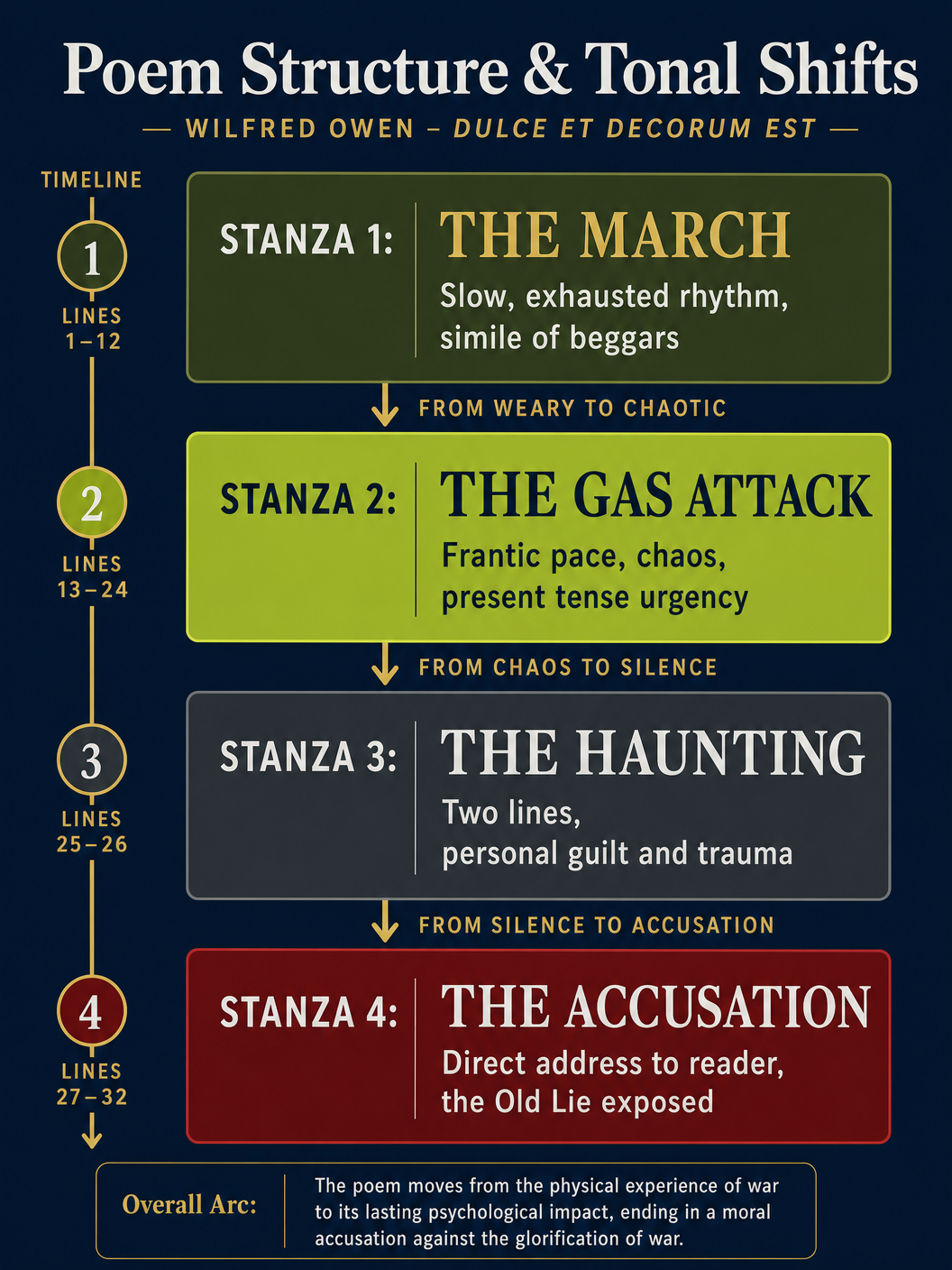
- Stanza 1 (The March): A group of exhausted, traumatised soldiers trudge away from the front lines towards their camp. They are described as physically broken and dehumanised.
- Stanza 2 (The Gas Attack): A sudden chemical weapon attack occurs. The soldiers scramble to put on their gas masks. One soldier fails to fit his mask in time and begins to suffocate in the toxic green gas.
- Stanza 3 (The Haunting): A brief, two-line stanza where the speaker reveals that he is continually haunted by the nightmare of watching his comrade die, unable to help him.
- Stanza 4 (The Accusation): The speaker directly addresses the reader (specifically targeting propagandists). He describes the horrific physical reality of the dying man in the wagon, concluding that if people saw this, they would not tell children the "old Lie" that it is sweet and fitting to die for one's country.
Themes
Theme 1: The Reality vs. The Myth of War
Owen contrasts the grim, grotesque reality of the trenches with the patriotic propaganda fed to the British public. He deliberately uses repulsive imagery to destroy any lingering romantic notions of battle.
Key Quotes:
- "like old beggars under sacks" (Stanza 1) - Strips the soldiers of their heroic military identity, replacing it with an image of poverty and premature aging.
- "The old Lie: Dulce et decorum est / Pro patria mori." (Stanza 4) - The capital 'L' in 'Lie' elevates the propaganda to a universal deceit. The use of Latin highlights the disconnect between educated, classical ideals of heroism and the muddy, bloody reality of modern warfare.
Theme 2: Physical and Psychological Trauma
Owen focuses intensely on the destruction of the human body and mind. The poem moves from physical exhaustion to acute physical agony, ending with lasting psychological damage (PTSD).
Key Quotes:
- "blood-shod" (Stanza 1) - A powerful metaphor compressing immense suffering; their boots are gone, and they walk shod only in their own blood.
- "In all my dreams before my helpless sight" (Stanza 3) - Highlights the inescapable nature of trauma. The adjective "helpless" emphasises the powerlessness of the individual in modern, industrialised warfare.
Theme 3: Guilt and Complicity
The poem shifts from a collective experience ("we") to an isolated trauma ("I/my"), and finally to a direct accusation against the reader/propagandist ("you").
Key Quotes:
- "My friend, you would not tell with such high zest" (Stanza 4) - The use of "My friend" is deeply ironic and bitter. It implicates the reader and those who glorify war without experiencing it.
Writer's Methods
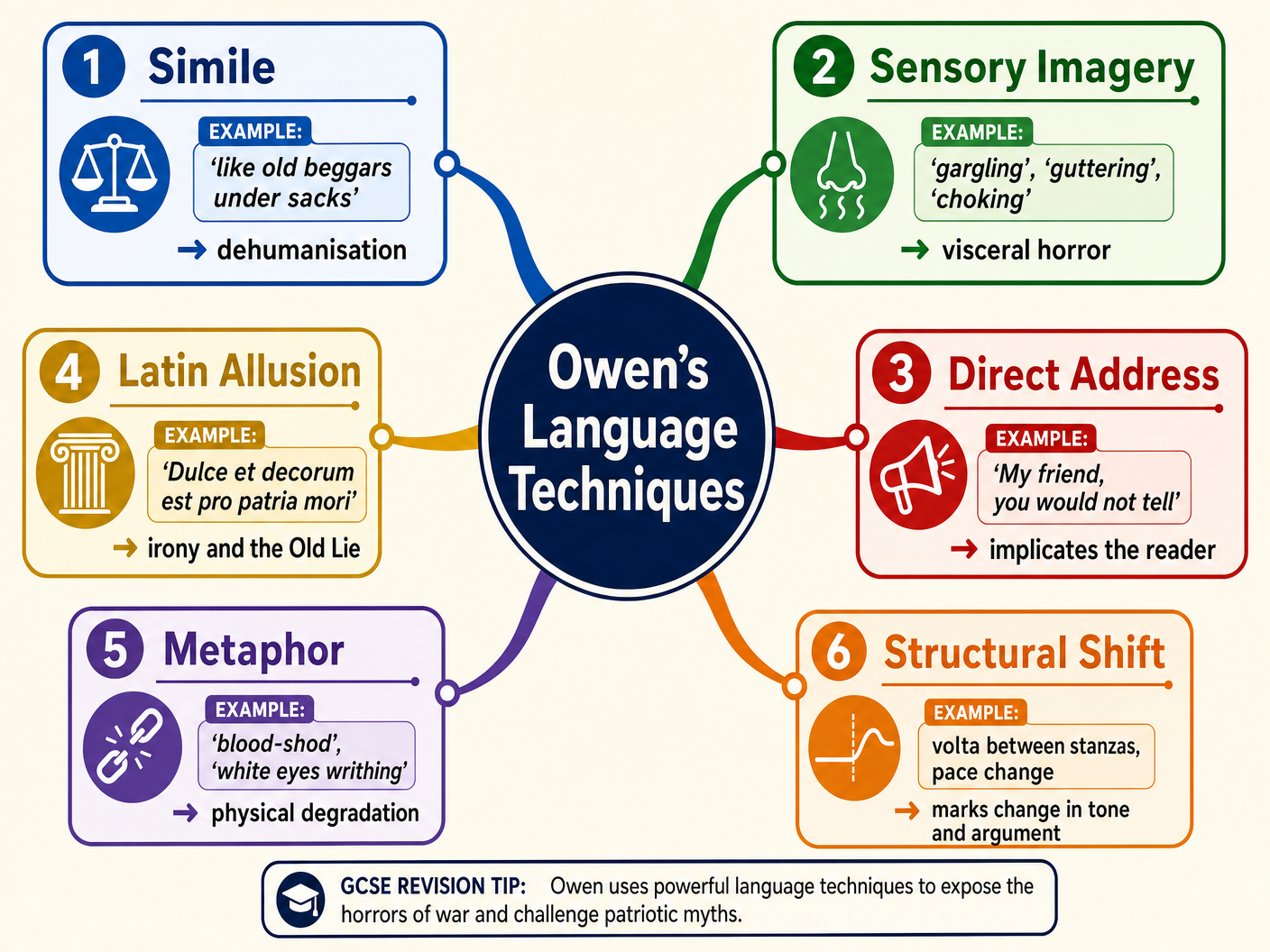
Sensory Imagery: Owen bombards the reader with grotesque sensory details. Verbs like "gargling", "guttering", and "choking" create a cacophony of horrific sounds, forcing the reader to vividly imagine the man's suffering.
Structural Shifts: The poem's rhythm mirrors its content. Stanza 1 uses broken, dragging iambic pentameter to reflect the soldiers' exhaustion. Stanza 2 fractures this rhythm with sudden exclamations ("Gas! GAS! Quick, boys!"), creating frantic urgency. Stanza 3 is isolated as two lines, representing the haunting isolation of trauma.
Simile and Metaphor: Owen's comparisons are deliberately unheroic. Comparing soldiers to "hags" or "beggars" subverts expectations. The metaphor of being "under a green sea" transforms the battlefield into an alien, suffocating environment.
Context
Wilfred Owen wrote this poem in 1917 at Craiglockhart War Hospital while recovering from shell shock. During this time, the British public was largely shielded from the true horrors of the war by strict censorship and jingoistic propaganda poetry, such as that written by Jessie Pope (to whom this poem was originally dedicated). The introduction of poison gas (chlorine and phosgene) in WWI represented a terrifying new form of industrialised warfare that stripped combat of any remaining notions of chivalry or hand-to-hand bravery. Examiners reward candidates who use this context to illuminate why Owen chose such aggressive, shocking language—he was actively fighting a war of words against the establishment.
Worked Examples
1 detailed example with solutions and examiner commentary
Practice Questions
Test your understanding — click to reveal model answers
Compare how poets present the physical effects of war in 'Dulce et Decorum Est' and one other poem from your anthology.
Hint: Focus on the sensory imagery Owen uses to describe the gas attack, and choose a comparison poem that also deals with bodily harm or physical exhaustion.
How does Owen use structure to convey the chaos of the gas attack?
Hint: Look at the punctuation, sentence length, and rhythm at the start of Stanza 2.